Jeopardy rules, scoring and wagering
Updated
The show's rulebook is longer than a homemade game needs, and copying all of it is how a party game turns into an argument about phrasing. This is the whole set, marked for which parts hold the format together and which are television conventions you can drop without anyone noticing.
The board
Six categories across, five clues down, values increasing with difficulty. On the show the first round runs $200 to $1,000 and the second round doubles it, $400 to $2,000. A single-round home game normally just uses the first ladder.
The increasing values are not decoration. They are how a player reads difficulty before committing, and they are what makes choosing a square a decision rather than a formality. A board with flat values is a quiz.
Play, in order
- A player picks a category and a value.
- The host reads the clue, which is phrased as a statement of fact.
- Buzzers open once the host finishes reading. Buzzing early locks a player out briefly on the show; at home, simply not opening the buzzers until you finish is enough.
- The first player in gives a response. The show requires it phrased as a question — "What is Lisbon" rather than "Lisbon".
- Correct: the value is added to their score, and they pick the next clue.
- Wrong: the value is subtracted, and the clue reopens to everyone else.
- If nobody answers, the host gives the answer and control stays with whoever picked last.
Control of the board passing to whoever was last correct is the rule most home games forget, and it matters: without it, one player can pick every square all game.
Daily Doubles
Hidden squares that, when picked, belong to that player alone — no buzzing. They wager before seeing the clue, then answer, and win or lose the amount they wagered.
The wager cap is the part people get wrong. A player may wager up to their current score, or up to the highest clue value on the board, whichever is greater. That second half is what lets a player on $200 make a real bet, and without it a Daily Double early in the game is worth almost nothing.
The show hides one in the first round and two in the second. For a home game, one or two on a single board is about right — more and the scores stop tracking who knew things.
Final Jeopardy
One clue at the end. The category is announced first, everyone writes a wager, then the clue is revealed and everyone writes a response. Correct adds the wager, wrong subtracts it, and all of it resolves at once.
Wagering is where Final is won or lost, and the leader's bet is set by the second-place score rather than by confidence. Going in, Ana has 12,000, Ben 9,000 and Cal 4,000. The most Ben can finish on is 18,000, so Ana wagers 6,001: if she is right she ends on 18,001, one point clear of anything Ben can reach. Both are right, and she wins by exactly that point. Had she missed, she would have dropped to 5,999, which is the price of covering.
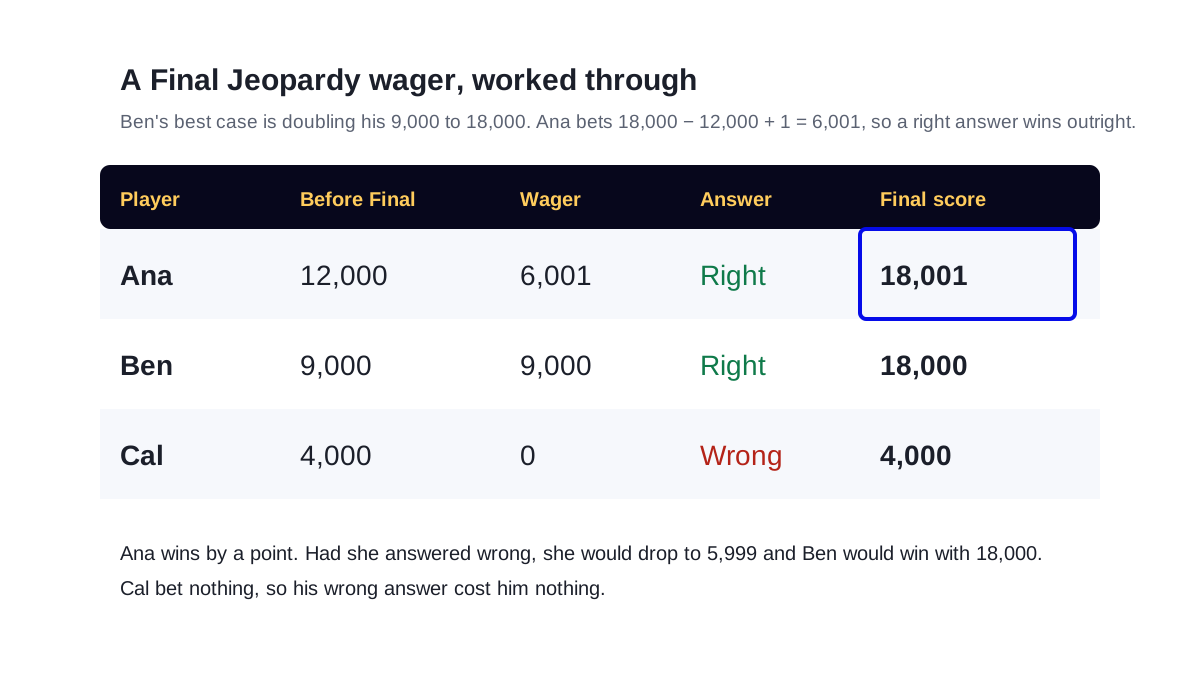
A leader with more than double the second-place score can make the game safe: any wager smaller than the gap between their score and twice second place guarantees the win even on a miss. It is worth explaining this to a room once, because it is the moment people realise Final is a strategy question as well as a trivia one.
The wager cap is a player's own score, so a player at zero or below cannot bet. Whether to let them play anyway is your call — in a classroom it is usually worth letting a team at -400 wager a fixed amount, since the alternative is a team with nothing to do during the best part of the game.
Final is the mechanism that keeps a game alive when someone is far ahead, which is why it is the one part of the format worth keeping even when you cut the board down.
Which rules to drop
| Rule | Keep it? | Why |
|---|---|---|
| Wrong answers subtract | Keep | Without it the right strategy is to buzz on everything and guess |
| Winner picks next | Keep | Stops one player from controlling the whole board |
| Wrong answer reopens the clue | Keep | Otherwise one hasty buzz kills a clue nobody got to try |
| Response phrased as a question | Optional | Produces arguments about phrasing rather than knowledge, especially with students |
| Two rounds with doubled values | Optional | Only if you have the time; a single round plus Final is a complete game |
| Buzz-in lockout for buzzing early | Drop | Only needed because television opens buzzers on a light, not a voice |
| A tiebreaker clue for a tie for first | Keep, if you name a winner | Keep one spare clue back for it; writing a fair one on the spot is harder than it sounds |
Running it
Make My Jeopardy applies the rules above so you do not have to track them: the board greys out played clues, correct answers move control, scores update live on the presenter view, and Final Jeopardy collects every wager before the clue is shown. Daily Doubles are a Pro feature; everything else here — the board, buzzers, scoring and Final — is on the free plan and needs no account.
Common questions
Do you have to answer in the form of a question?
On the show, yes, and a response that is not phrased as a question is ruled incorrect in later rounds. In a home or classroom game it is a style choice. If you are enforcing it, say so before the first clue rather than on the first violation.
What is the maximum Daily Double wager?
A player's current score, or the highest clue value on the board, whichever is larger. That means a player with a low score can still make a meaningful wager early on.
Can you go negative in Jeopardy?
Yes. On the show a contestant with zero or less at the end of the second round cannot play Final Jeopardy. In a homemade game there is no reason to enforce that, and letting a trailing team wager a fixed amount keeps them in the game.
How many Daily Doubles should a homemade board have?
One or two on a single 6 x 5 board. The show uses one in the first round and two in the second, across sixty clues — matching that density on thirty clues means one, and two is already generous.
What happens if nobody buzzes in?
The host reads the answer and control of the board stays with whoever selected the clue. Nobody's score changes.
How does Final Jeopardy wagering work?
The category is announced, then every player secretly writes a wager of anything from zero up to their current score. The clue is revealed, everyone writes a response, and each wager is added for a right answer or subtracted for a wrong one. The leader usually bets enough to beat second place doubling up — with 12,000 against 9,000, that is 6,001.
What happens if there is a tie in Jeopardy?
On the show, a tie for first place after Final Jeopardy is broken with one extra clue for the tied players, played as a buzz-in. Ties for other places are left alone. In a home game, do the same if you are naming a single winner, and write the tiebreaker clue in advance.
What is a true Daily Double?
A Daily Double where the player wagers everything they have — the phrase comes from contestants saying "let's make it a true Daily Double". It is not a separate rule, just the largest bet the ordinary cap allows.
Can a player with a negative score wager on a Daily Double?
Yes. The Daily Double cap is the player's score or the highest clue value on the board, whichever is larger, so a player below zero can still bet up to that top value. Final Jeopardy is different: its cap is the player's own score, so a player at zero or below has nothing to wager.
Boards to play
Ready-made, with every clue written. Copy one and change what you like.
General Knowledge Jeopardy
Classic pub-quiz territory, six ways: maps, history, science, the arts, sports, and a grab bag. A free copy and a few phones make it a full trivia night.
80s Trivia Jeopardy
Synth-pop, blockbusters, and mall-era fads: a whole board of 1980s nostalgia that any host can copy for free and run with phones as buzzers.
90s Trivia Jeopardy
Dial-up, boy bands, and Saturday morning cartoons return for one night. The 90s board costs nothing to copy and runs on phone buzzers, not dial-up.
Pop Culture Jeopardy
Chart hits, blockbusters, binge-worthy shows, and internet lore on one loud board. Anyone can copy it without paying and host it with phone buzzers.
Halloween Party Trivia Jeopardy
Horror films, classic monsters, ghost stories and the holiday's own history on a board for grown-up Halloween parties. Copy it free, buzz in by phone.
Christmas Trivia Jeopardy
Carols, holiday films, Santa lore and traditions from around the world on one festive board. Free to copy, and guests buzz in from their phones.
Make one now
A 6 × 5 board with phone buzzers, live scoring and Final Jeopardy — free, no account. Or copy a ready-made board.
Keep reading
How to make a Jeopardy game
How to build a custom Jeopardy game: how many clues you need, writing clues that play, the scoring rules, and how to run it on the day.
How to run a Jeopardy review game in class
How to run a Jeopardy review game the whole class plays: team setup, timing, scoring that keeps quiet students in, and the usual failure modes.
How to give everyone a buzzer
The four ways to run buzz-in — shouting, hands, hardware buzzer sets and phones — and what each costs in fairness, setup time and arguments.